Category Archive: Possible-opolis

  1. Brain Builders: Restaurant Game

    Leave a Comment

    by Heather Davis, MCM Early Learning Manager

    In honor of both Madison Resturant Week (this year in a to-go format!) and our Pie-in-the-Sky diner, which is a favorite exhibit at Madison Children’s Museum for many of our visitors, we present a special restaurant theme for Brain Builders!

    Miss going to your favorite restaurant? Try playing restaurant at home! Children love to role play, and they also love to help with real household tasks. 

    Can they help with setting part of table? Can they take drink orders? Or circle a food choice on a pretend menu? 

    At the Pie-in-the-Sky diner in the museum, kids love to make pizzas and pies. Our “ingredients” are made by an artist out of up-cycled sweaters, but you can make your own play food out of old clothes or other things you have around the house like cardboard for crusts and shredded paper for cheese. Or go a step further and let them actually help make snacks. In a recent Exploration Stations, Cheryl had some great ideas on how to get little kids cooking and Joyce shared even more ideas for cooking on our blog!

    Dinner can be a hectic and busy time. Part of dining in a restaurant is also practicing patience, using an indoor voice, and entertaining yourself at the table while waiting for your meal. Simply playing “restaurant” can encourage those behaviors. 

    There are also quiet games you can play together (or solo) at the table: a short crossword puzzle, hangman, the dot game, mazes, drawing games, etc.  

    From planning a menu, to creating food, to waiting to be served, playing restaurant is a Brain Builder!


    Brain Builders is part of MCM at Home. Follow us on social media for more tips, games, crafts, and ideas to learn through play at home.
  2. Week of the Young Child—Music Monday

    Leave a Comment

    WotYC 2018 FB header

    This week we’re pleased participate in the Week of the Young Child. Organized by the National Association for the Education of Young Children, the Week of the Young Child is an annual celebration of early learning, young children, their families, and teachers—and that includes the expert staff at Madison Children’s Museum! They make sure that our exhibits and programs meet the highest standards for educational and developmentally appropriate play and learning.

    Follow our blog this week to learn about the key themes that are being highlighted during the 2018 Week of the Young Child, and how you can take advantage of our resources and programs for your early learner.


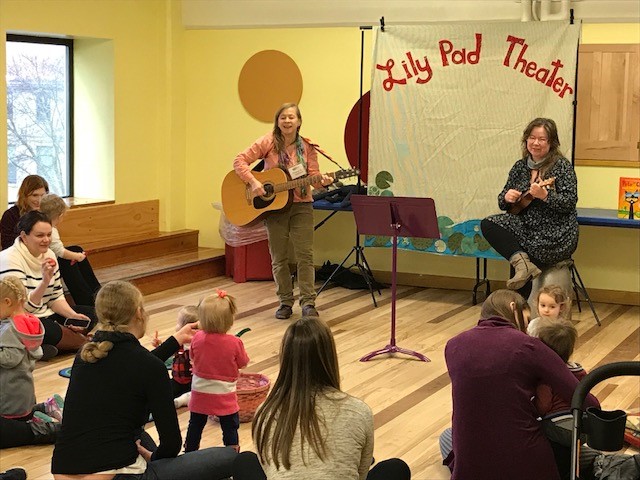
    Lily-Pad Theater at Madison Children's Museum

    Music Monday

    Listening to and playing music is a joyful act of childhood and connects us to our family and our community. There is a reason that singing to children has become an essential part of early learning curriculum. Children learn language and concepts particularly well through singing because music stretches out the sounds, making it easier for them to detect words and their meanings. Music also helps kids with literacy and math skills as they learn rhythm and beats.

    At Madison Children’s Museum, we learn through music during weekly programs like Music with Junebug and Lily-pad Theater. You can also try out making your own rhythm with the drums or shakers in the Wildernest.

    Music with Junebug

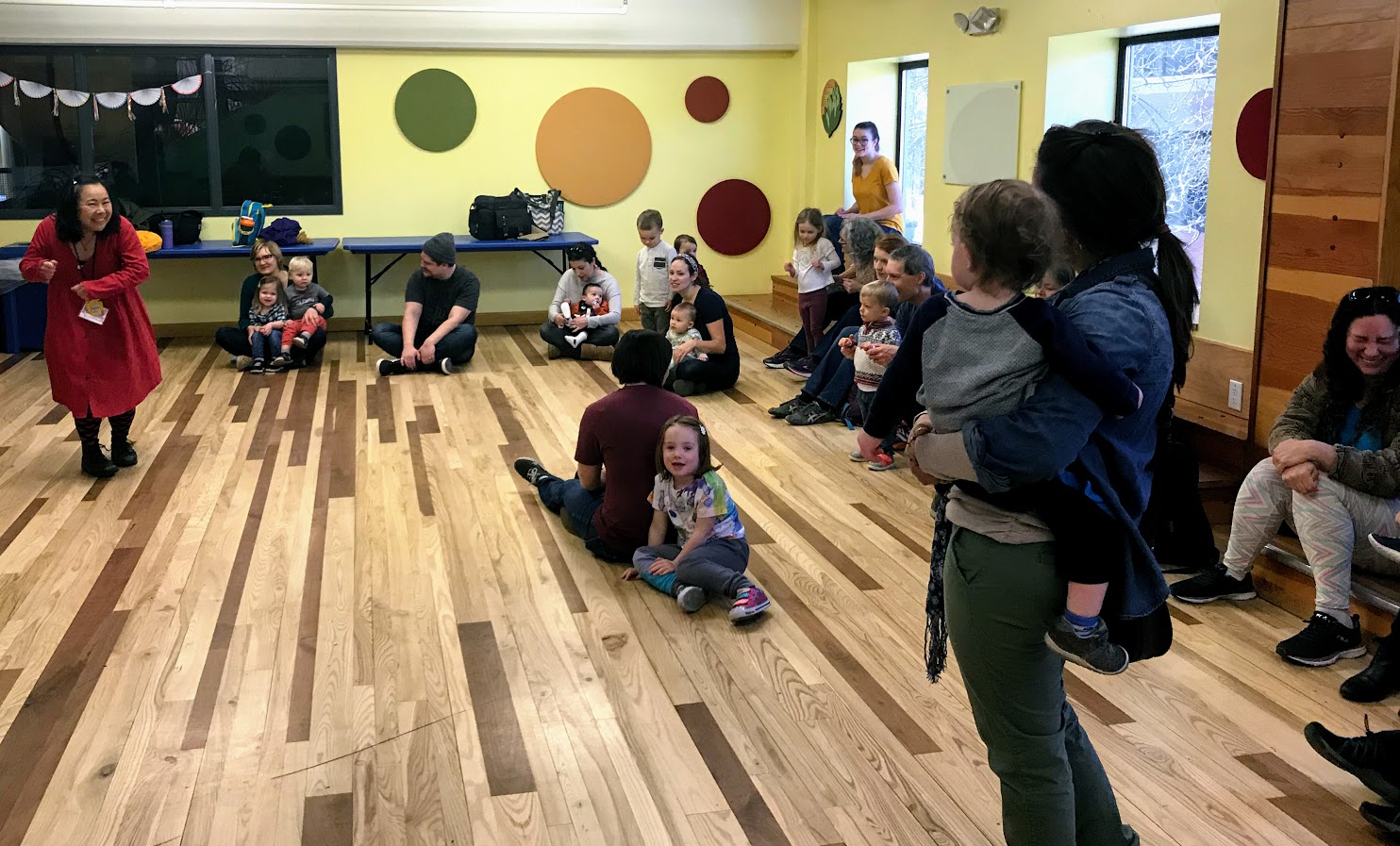
    Junko greets a new arrival during Music with Junebug, held at the museum on Wednesdays.


    Week of the Young Child coincides with our Access for Everyone campaign. Please consider making a gift to help us provide these benefits to all children within our community.

  3. Learn From Nature

    Leave a Comment

    By Joyce Hemphill (Queen of Play)

    37497286391_302a7ab8ef_o

    My young neighbor was telling me about a nature walk she took with her mom. They set out looking for ‘signs of spring.’ They came across plenty of birds, specifically robins, and saw a wide array of flowers. One flower stood out. She couldn’t remember the name, but it was small and purple, with leaves that looked like hearts. Her brother chimed in, saying “We also saw a bright yellow flower on a long stem, and it was round and had lots of small leaves that looked like a row of triangles. Can you guess what flower we saw?”

    Isn’t nature amazing with all of its colors, shapes, textures, patterns, smells, and sounds? Nature merges the classroom and the playground, expanding the possibilities for open-ended play in an environment that encourages creativity. Go outside and take a look. Nature provides a perfect resource for playing scavenger games. These games are simple and effective learning activities that engage children with the natural world while helping develop observational, analytical, and memory skills that carry over to the classroom. For example, while at the park or on a walk in your neighborhood do a “Where’s ROY G BIV?” search and be on the lookout for any Red, Orange, Yellow, Green, Blue, Indigo, and Violet.

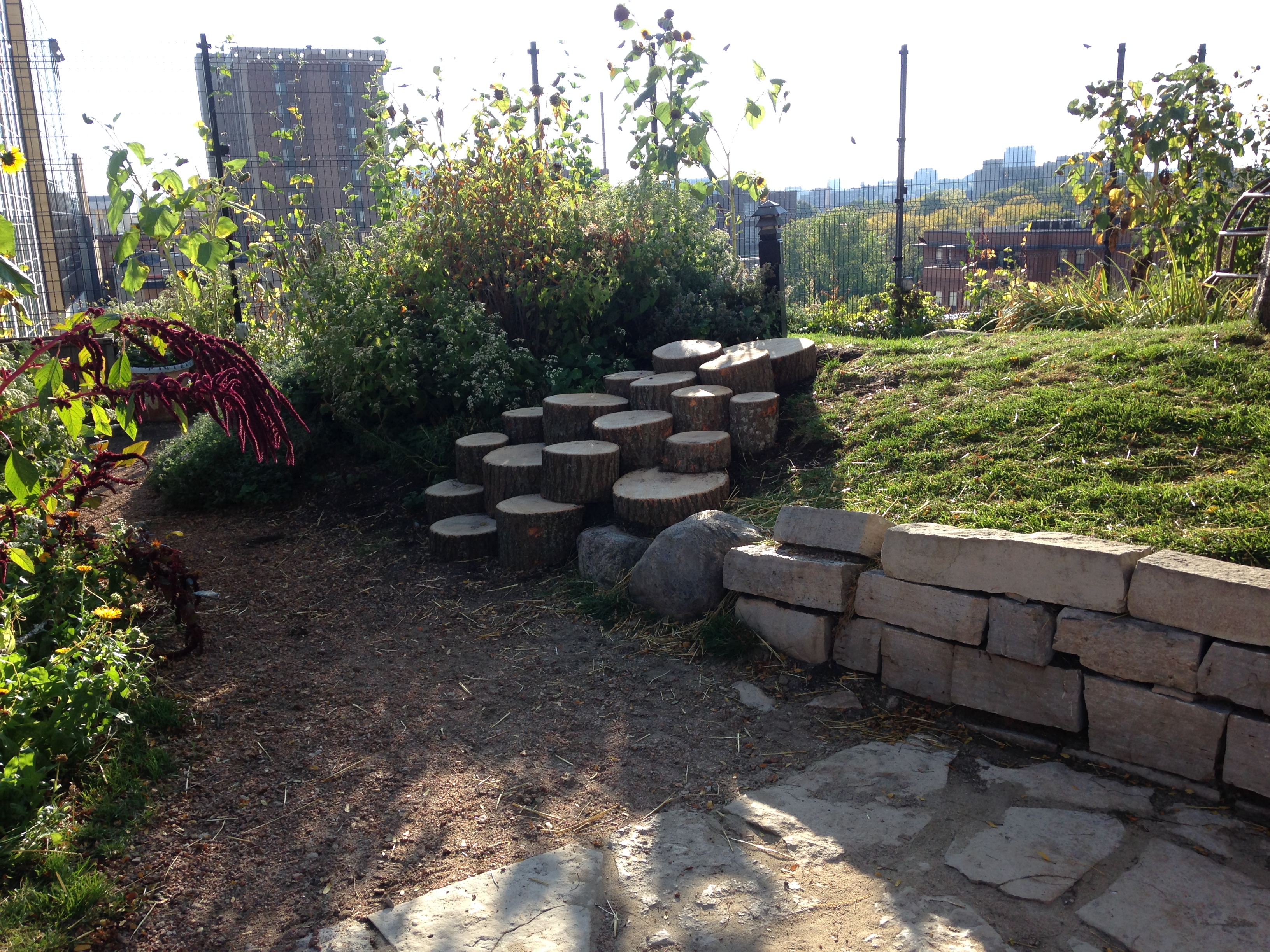
    Nature-based scavenger games can also be played in the outdoor spaces at the Madison Children’s Museum. Check out the Rooftop Ramble, Urb Garden, and Wildernest for examples of naturally occurring squares, circles, triangles, and other geometric shapes. Look for examples of symmetry and asymmetry in the various plants and animals you come across. Take a more focused look at spaces you have played in before and perhaps you will see something in a new way.

    Wisconsin native and celebrated architect, Frank Lloyd Wright, encouraged his students to not only study nature, but to fall in love with its wonders and beauty. Nature was Wright’s mentor, and its influence shines through in his work. The patterns and shapes in his designs echo the natural beauty of the outdoors

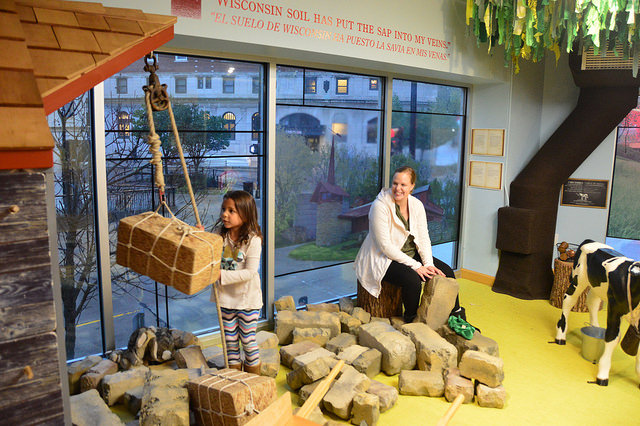
    The museum’s Frank Lloyd Wright inspired From Coops to Cathedrals exhibit will expand your options for play, including nature-based scavenger games. Not only can you do a search for ROY G BIV and scavenge for shapes, you can test your identification skills by matching the patterns you see inside the museum with those in nature.

    24270075118_eb68c82ece_z

    I encourage you to become a student of nature. Explore, investigate, compare, contrast, wonder, snoop, seek, and find.

    (YiP) Yours in Play

    Joyce

    BTW, did you figure out what flowers my neighbors saw? Answer: Wild violets and dandelions.

  4. What do you think of this exhibit?

    Leave a Comment

    By Tim Dreyer
    Possible-opolis Manager

    Among our many relationships with the University of Wisconsin-Madison, is an ongoing collaboration with engineering students working on their final Senior Capstone project, where they will be designing a prototype exhibit for MCM.

    This year Jacob Kahn, Marie Floyd, Matthew Terrance, Nicholas Czech, and Olabimpe Olaniyan are designing an exhibit to help teach children about tools & fasteners. They are looking for your feedback to help shape their design, so please take a moment to look at their initial video proposal and offer any ideas or impressions you may have in the comments below.

    https://www.youtube.com/watch?v=g4x6z4l0eQ4

  5. Enigma: Panic at the Wayback

    Leave a Comment

    The Wayback Machine has many secrets for you to discover. Don’t assume it’s broken; keep trying and figure it out!WB photo 1

    By John Robinson, Madison Children’s Museum Exhibits Developer
    (Reprinted from hand to hand, a journal from the Association of Children’s Museums)

    In early 2010, as the Madison Children’s Museum (MCM) team toiled away building its expanded new facility, it became clear that quadrupling the exhibit space on a very tight timeline and an even tighter budget was going to be taxing. Soldiering through the worst economy in recent U.S. history, what kept staff energized was that these challenges also produced unusual opportunities that might not have emerged under more favorable circumstances. (more…)

  6. Create with SCRATCH!

    Leave a Comment

    Are you interested in creating your own interactive art, animated stories, or games? In this class you will create original programming projects using SCRATCH software.  Developed at MIT, SCRATCH is a highly-visual programming language developed specifically for beginners to create almost any idea imaginable!

    This class will be led by Computer Science students from The University of Wisconsin-Madison as part of a service-learning course.
    When: Sundays (more…)