How can we begin to imagine the potential harnessed power of the sun and the wind?
Forces of Nature is a new initiative, recently installed on the museum’s Rooftop Ramble, that uses a windmill and solar-powered flowers to teach children about sustainable ways of collecting, producing, and using wind and solar energy.
The new wind-generated water pump will help children visualize and understand the power of the wind. At first glance, it looks like an ordinary windmill you’d find on a farm. But look closer and you’ll find that the wind powers a pump which draws water up and then sends it cascading through a Rube Goldberg–style machine until it is collected in a tuba-like horn at the bottom.
A solar flower feature, where flowers move with the sun’s energy, provides opportunities for children to experiment with solar energy: Move the pads to cover or uncover the solar panels and watch the giant metal flowers respond as they spin above.
These Forces of Nature features complement the long-standing rooftop solar panels installed on the roof. We’ve also added a bird-themed, model electric car to the Clubhouse.
Information on sustainable energy is readily available online and in books. But learning about solar and wind power in an interactive and beautiful environment—with the wind and the sun on a child’s skin as they explore—will teach lessons that will be uniquely understood and remembered.
We hope Forces of Nature will expand children’s understanding of sustainable energy, planting the seeds for a society better prepared to use sustainable energy systems.
Forces of Nature exhibit components were generously supported by Madison Community Foundation, MG&E, and Endres Manufacturing Company Foundation. Watch for phase II rooftop improvements in September of 2019.
The museum is working on two major improvements, which will require short-term and long-term closures.
Our Rooftop Ramble—which includes a sprawling rooftop flower and edibles garden, a combination chicken coop and homing pigeon cote, the acorn climber and “crow’s nest” lookout tower, and the indoor clubhouse which houses our education animals and science exploration activities—is one of the most iconic and beloved parts of Madison Children’s Museum. This spring we are kicking off a multi-stage project to refresh our rooftop spaces, bring in even more science and environmental education opportunities, and make visiting the roof more accessible for all our guests.
A view of Madison Children’s Museum’s rooftop ramble at the time the museum opened in 2010.
The whole rooftop floor is closed from April 1 through May 15, 2019. During that time, exhibits and facilities staff will complete Phase 1 of upgrades and additions. When the rooftop reopens there will be two new features installed. One is a windmill, which will engage wind power to lift water from a well below. The other is a large mechanical flower, whose movements will be powered by solar energy. You’ll also see changes to increase space inside the Clubhouse.
Our outdoor community spaces will be getting an upgrade to make them more accessible.
Phase 2 will be completed during our traditional closed weeks this fall, September 3 through 13. These changes will focus on making the rooftop more accessible for all users, including those with mobility devices.
Also, our Log Cabin will be closed until further notice. Though the Log Cabin itself is in fine shape, further erosion of the former parking structure out back, hastened by the extreme freeze/thaw cycles we experienced late this winter, necessitates closing down use of the back lot. This is not a surprise, as we were informed the back lot had an approximate ten-year lifespan when we acquired the building in 2005. And we are now well past that point. However, we know the Log Cabin is a beloved part of Madison Children’s Museum, and we are sorry to not be able to reopen it this spring, as we usually would.
The log cabin and garden, pictured here in 2013, will reopen in a few years.
So what’s next? The Log Cabin will be back within a few years. It will reopen as part of a major expansion project planned for the entirety of the back lot. This project is still in planning stages, so details are under wraps, but we can assure you that it will be worth the wait and that things are looking… Up.
We’re sorry for any inconvenience these closures cause. During the rooftop closure (through May 15), we are discounting regular admission to $7 for adults and children above the age of one and $6 for seniors.
In Downtown Madison, the planning of a new hotel can be fraught with controversy and lengthy negotiations between the city and private builders. The issues can take years to resolve before ground is broken: Will TIF money be used? Will the hotel be granted a variance to build more stories than code allows?
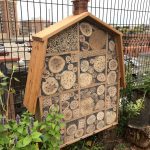
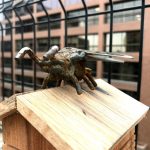
So it’s remarkable that Madison Children’s Museum has been able to quickly plan and build a hotel—using no public funding—delivering the project on time and on budget. Or it might be most remarkable that this Insect Hotel caters to those with six or more legs!
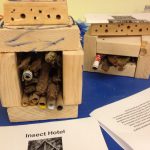
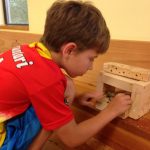
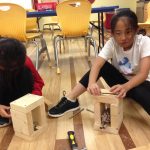
Insect hotels are a concept that is rapidly catching on in urban gardens and green spaces. Made out of natural materials, insect hotels have plenty of hidey-holes and little crevices where bugs can find a safe and warm shelter. Kids attending one of the museum’s summer camps created mini-insect hotels (pictured below) as one of their building projects.
Creating mini-insect hotels have been part of programs at the museum’s summer camps.
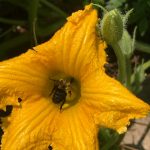
Insects are an important part of the ecosystem, even in an urban environment. They pollinate our urban gardens, get rid of food scraps—and some even control the populations of less welcome neighbors like mosquitos. But as Madison builds densely to maximize every inch of our urban landscape, we eliminate the safe places for our insect friends.
In particular, insect hotels benefit solitary bees. When thinking of bees, hives and honey generally come to mind, but the majority of the bee population is made up of individual bees. These solitary bees do not live in colonies or hives, but rather burrow in the ground or live in small holes in wood or other natural materials. Over 500 bee species live in Wisconsin, and many of these are threatened or endangered. Last year the endangered Rusty Patched Bumblebee was photographed by a pedestrian doing citizen science on Hamilton Street near the museum, so we know these bees live in our urban habitat. We just need to give them good housing to do so!
This fall Madison Children’s Museum added an Insect Hotel to our Pleasant T. Rowland Rooftop Ramble and will be introducing education programming about bees and other pollinators important to our ecosystem. The Rooftop Ramble is one of the most popular areas of the museum. It consists of a green rooftop with a four-season garden where kids can experience the great outdoors in the heart of downtown Madison. With the addition of the Insect Hotel, visitors will learn about the important contributions that insects make to our health, our food supply, and our environment.
The insect hotel “opens for arrivals” during Free Family Night on Wednesday, September 19, 2018. The theme of the night is Entomology Exploration. In addition to the grand opening and ribbon cutting of the insect hotel at 5:30 p.m., there will be Insect Art in the Art Studio from 6–7:30 p.m. and a special Learn about Insects program on the roof, also from 6–7:30 p.m.
Steve Zanoni is general manager of the Madison Concourse Hotel & Governor’s Club, down the block from the museum. We asked him how he felt about a new, competing hotel opening so close by. “Of course we always need to watch the competition,” said Zanoni. “And we will probably lose some of our customers who are bees; that’s unavoidable and unfortunate. But human visits to Madison are increasing—I’m confident we can stay in business. Badger fans or wedding guests staying for the weekend are more likely to schedule a day trip to the museum rather than try to cram themselves into the tiny Insect Hotel overnight, which, frankly, does not offer the quality amenities of our hotel.”
My young neighbor was telling me about a nature walk she took with her mom. They set out looking for ‘signs of spring.’ They came across plenty of birds, specifically robins, and saw a wide array of flowers. One flower stood out. She couldn’t remember the name, but it was small and purple, with leaves that looked like hearts. Her brother chimed in, saying “We also saw a bright yellow flower on a long stem, and it was round and had lots of small leaves that looked like a row of triangles. Can you guess what flower we saw?”
Isn’t nature amazing with all of its colors, shapes, textures, patterns, smells, and sounds? Nature merges the classroom and the playground, expanding the possibilities for open-ended play in an environment that encourages creativity. Go outside and take a look. Nature provides a perfect resource for playing scavenger games. These games are simple and effective learning activities that engage children with the natural world while helping develop observational, analytical, and memory skills that carry over to the classroom. For example, while at the park or on a walk in your neighborhood do a “Where’s ROY G BIV?” search and be on the lookout for any Red, Orange, Yellow, Green, Blue, Indigo, and Violet.
Nature-based scavenger games can also be played in the outdoor spaces at the Madison Children’s Museum. Check out the Rooftop Ramble, Urb Garden, and Wildernest for examples of naturally occurring squares, circles, triangles, and other geometric shapes. Look for examples of symmetry and asymmetry in the various plants and animals you come across. Take a more focused look at spaces you have played in before and perhaps you will see something in a new way.
Wisconsin native and celebrated architect, Frank Lloyd Wright, encouraged his students to not only study nature, but to fall in love with its wonders and beauty. Nature was Wright’s mentor, and its influence shines through in his work. The patterns and shapes in his designs echo the natural beauty of the outdoors
The museum’s Frank Lloyd Wright inspired From Coops to Cathedrals exhibit will expand your options for play, including nature-based scavenger games. Not only can you do a search for ROY G BIV and scavenge for shapes, you can test your identification skills by matching the patterns you see inside the museum with those in nature.
I encourage you to become a student of nature. Explore, investigate, compare, contrast, wonder, snoop, seek, and find.
Madison Children’s Museum is celebrating the 100th anniversary of the Wisconsin State Capitol with a series of seasonal events and kids’ workshops. The museum’s participation in this event is in partnership with the Madison Community Foundation and their Capitol Century grant, an initiative of their anniversary year of giving.
On Saturday, November 18, the museum lights up for Shine On Madison. At 6:08 p.m. downtown Madison will come alive as all of the holiday lights — from businesses, cultural establishments, and the city’s own decorations — all turn on at the same moment. Madison Children’s Museum is delighted to be a part of this downtown-wide celebration.
Here’s how we’ll help celebrate the first ever Shine event: On Saturday, November 18, the museum will be open to the public with free admission from 5 to 8 p.m. Visitors are invited to join in special activities, including lantern-making on the Rooftop Ramble, and building a capitol playhouse in the Art Studio. In the museum’s rooftop garden, the Capitol building will be replicated in a very different format: the museum’s popular rooftop climbing structure has been reimagined as the nearby Capitol dome, and will be illuminated from within at 6:08 p.m. The rooftop capitol will remain as a winter-long part of cold-weather activities at the museum.
The Wisconsin State Capitol building as seen from Madison Children’s Museum
Also during the Shine On Madison celebration, the museum’s newest Sidewalk Surprise art installation will open. Mini Caps celebrates the Wisconsin State Capitol building with tiny capitol buildings in many different artistic styles, created by local artists Justin Bitner, Cheryl DeWelt, Renee Earley, Eric Ford, Martha Glowacki, Tracey Honn, Angela Johnson, Erika Koivunen, Chris Murphy, Jeff Repko, Grace Sullivan, John Taylor, Michael Ward, and Claire Wilson. Visible from both the museum’s lobby and the N. Hamilton Street sidewalk, the art installation demonstrates how the same iconic building can inspire artists in many differing ways.
The capitol-inspired activities continue into the holiday season. Within the museum, even more capitol buildings will be constructed using two fundamentally different, kid-friendly, materials: plastic Lego building blocks and gingerbread.
The gingerbread house–style capitol is being laser-cut by Sector67, and will be constructed in stages, over the weekend of December 2 and 3, 10 a.m. to 4 p.m. Simultaneously, traditional gingerbread houses will be created and displayed during the museum’s annual Casas for CASA event, which supports court-appointed advocates for abused or neglected children.
The evening of December 6 will be Lego Capitol night at Madison Children’s Museum. As part of the museum’s monthly Free Family Nights, which offer special programming and no-cost admission to the public, the first 200 kids will receive their own Lego mini-capitol building kit. A much larger Lego model of the capitol will be on display that evening, with construction completed by the artist as children watch.
In addition to the capitol-themed special weekend events, several of the museum’s drop-in programs will involve capitol, architecture, and building themes, encouraging kids to find their inner architect though building and sculpting with unconventional media. These programs nicely complement Coops to Cathedrals: Nature, Childhood, and the Architecture of Frank Lloyd Wright, the museum’s newest exhibit, exploring the inspirations of the famous architect.
The numerous interpretations of capitol buildings, ranging from less than an inch tall to several feet tall, contrasted with the magnificent capitol building so clearly visible from the museum’s front door, will inspire children to consider the history and art that is part of their daily lives in Madison. The Madison Children’s Museum is grateful to the Madison Community Foundation for their support of this innovative, imaginative project.
By Corinne Burgermeister Communications Coordinator
Whether kids are crafting out of recycled materials in the Art Studio, using chalk in the Funkyard or making music on our colorful piano, something artsy is always happening at Madison Children’s Museum.
This summer we are offering several new drop-in programs where kids can get creative and make something totally unique. Here are six programs kids (and adults!) will enjoy.
Nature and Art Wednesdays, through August 26, 10:30 – 11:30 a.m.
Head to the Rooftop Clubhouse to create works of art inspired by our four-season garden roof. Topics will include plants, animals, weather, soil, the earth and sky.
Kids Makerspace: Art Studio Wednesdays, Thursdays, Fridays, through August 28, 1 – 3 p.m.
During our Makerspace open hours, guests can stop by our Art Classroom to participate in community arts projects related to our monthly theme. June– Let’s make a puppet show:Create your own puppets using materials in the Art Studio and put on a performance at our mini-theater. July– MCM Print Shop:Participate in interactive printmaking activities including screen-prints and letterpress. August – Paintapalooza: Celebrate all things painted! Create a piece on our paint wall or paint a portrait to take home.
Three Greek Myths Saturday June 27, 2:30 – 3 p.m. Visiting artist Felice Amato will present a short puppet performance of three ancient Greek myths using props and objects that she has created with visitors.
Clay Workshop: Peace Tiles Saturdays through August 29, 1 – 3 p.m.
Explore what it means to live in peace with our environment and those around us through art. Visit us Saturday afternoons to sculpt images that remind us of peace into clay tiles for a community art project. The clay creations will be used as elements for the Peace Mosaic being created on the walls of Madison’s Social Justice Center.
Drumming with JuneBug Mondays, July 6 through August 10, 1 – 1:30 p.m.
Local group JuneBug will visit the Funkyard weekly to lead guests in a drum circle. Kids of all ages can join in rhythm games and dance using recycled instruments.
Loom Tour: Backstrap Weaving July 9, 10 a.m. – 4 p.m.
Artist Hannah Bennett will spend the day preparing a backstrap loom system and demonstrating weaving – an ancient technique used in many cultures around the world. Kids will learn how to use weave using materials come from plants as well as recycled and upcycled pieces.
By Corinne Burgermeister Communications Specialist
This winter, Madison Children’s Museum is participating in Project FeederWatch, a national bird-watching program. The program, which started in the 1970s, is a winter-long survey of birds that visit feeders at backyards, nature centers, community areas, and, this year, at MCM’s Rooftop Ramble.
Participants count the birds seen at their feeders and send data to Project FeederWatch, which is run by the Cornell Lab of Ornithology. The data is then used to track broadscale movements of winter bird populations and long-term trends in bird distribution and abundance.
Alex Jeffers, MCM Discovery Guide
What can you tell us about yourself?
I have a BA in Sustainability from Baldwin Wallace University, which is an environmental science degree that incorporates classes in economics, political science, business, and sociology. The program focused on taking well-rounded approaches to environmental issues. Before coming to Madison, I worked as a Naturalist for Cleveland Metroparks in Ohio. There I led educational programs for schools, public hikes and classes, and coordinated citizen-science programs such as Project Feederwatch (among others).
Where did you first hear about Project FeederWatch?
I first heard about the project while working at a park district in Cleveland. It was there that I saw how projects such as this, and Cornell’s many other incredible citizen-science programs, helped to ignite people’s passion for birds and conservation in general. About a month ago, Rooftop Ramble Manager Julie King asked me if I had any experience with the program and I got excited just hearing its name again.
Why is this a good project for MCM to get involved in?
The world of birds is so different than our own that even when we get just small glimpses of it, such as at our bird feeders, it can immediately fill us with fascination and excitement! Creating a space and time for kids to dive into birds and embrace that fascination not only gets them jazzed about learning, but helps to build an ethic of respect for other living creatures that we share the museum with on a daily basis.
Can anybody participate in Project FeederWatch?
Of course! Anybody visiting the museum is welcome to come up during the program (Wednesdays and Thursdays from 2 – 3 p.m.) to learn more about birds, citizen-science, and how we can create a thriving space for people and wildlife right in downtown Madison! For those who aren’t able to make it to the museum, or who would like to get more involved, anyone can register their home-feeders and participate in their own backyards.
What can kids learn by participating in Project FeederWatch?
They’ll learn to tell different bird species apart from each other, why some birds come to our roof (and even to specific feeders) and others do not, why it is important to create habitat and food sources for birds in cities, and all the ways that people can contribute to research and habitat restoration all over the country.
What can kids and families expect to do during this drop-in program?
Participants will join me in watching the bird feeders set up on the rooftop and counting how many of each species visit the feeders. They will also be able to ask questions about birds and even check out the homing pigeons and chickens that call our rooftop home.
Typically, what birds do we see on our rooftop? Will that change with winter weather?
The weather definitely has an effect on the types of birds here in Madison, so Project FeederWatch specifically focuses on birds that visit feeders during the winter, when birds have a harder time finding other food sources. The birds we have seen so far eating at our feeders are American Goldfinches, House Sparrows, and Black Capped-Chickadees. As the winter continues and more birds begin to find our feeders, I expect that we will have new species frequenting our rooftop.
What types of food do we have in our bird feeders?
Since it becomes hard to stay warm when the temperatures drop, it is important to have high-fat foods at feeders during the winter. We have peanuts, sunflower seeds, suet, and thistle (a favorite of Goldfinches year-round).
What sort of data or information are we tracking? And how?
Project FeederWatch tracks the diversity of birds using feeders and the numbers of birds within each species. By counting every bird that comes to the feeder within a certain time frame, we can begin to understand which birds are more dependent on these man-made food sources.
American Goldfinch. Photo: Audobon
How will Cornell and other scientists use this data?
Cornell compiles Project FeederWatch data from all over the country to paint a comprehensive picture of how bird feeders are affecting the populations of certain species of birds compared to others. This can give important insights into how we can best create habitat and food sources for the largest number of species in our cities.
What are you most excited about or hoping to learn?
Personally, I am excited to get a better understanding of how our rooftop garden is benefiting birds in Madison. It is so important to create pockets of habitat, such as our Rooftop Ramble, in cities that are dominated by concrete and steel. This will help us better guide our efforts at MCM in adding to Madison’s bird populations.
Also, being an avid bird-watcher myself, I am beyond excited to spark excitement and fascination for birds (and all wildlife) in the hearts of the kids visiting MCM. Hopefully this will contribute to an ethic of respect for all living things in the coming generations.
Project FeederWatch occurs on the Rooftop Ramble Wednesdays and Thursdays from 2 – 3 p.m. through early April. Alex is also happy to spend time watching the feeders and talking about birds with visitors throughout the day. All rooftop staff are very knowledgeable about the wildlife we have at the museum and are eager to speak with visitors!
Not only is Madison Children’s Museum located in the heart of downtown Madison, the museum itself was created with a lot of area heart. During construction, museum organizers focused on being local and sustainable, including working with area architects, designers, artists, and fabricators. The result is a beautifully revamped 1929 building upgraded using green and regionally reclaimed materials. Filled with floors of exhibits children love, MCM is a working example of how to better care for our planet–on Earth Day and every day!
Urb Garden Greenery
The museum’s newest outdoor exhibit inspires visitors to grow their own food at home, whether in a large sunny yard or a tiny shaded windowsill. This green utopia is the perfect place for children to first dig into vertical gardening, aquaponics, and more planet-friendly growing.
Rooftop Solar Power
On top of the rooftop Clubhouse, solar panels donated by Madison Gas & Electric turn sunlight into energy. A working solar oven and a chicken exhibit that visually measures collected energy each give kids a hand-on way to check out how the power of the sun can be turned into useful electrical currents.
Kids Who Compost
Madison Children’s Museum is a test site for the City of Madison’s pilot compost program, designed to keep waste out of local landfills. Here, visitors can compost all kinds of materials, from garden scraps to paper waste—even diapers—and learn how easy it is to compost at home.
Did you know that maintaining livestock generates more of Earth’s greenhouse gasses than does transportation? These greenhouse gasses are a major contributor to global climate change. But don’t bug out! Insects are the most eco-friendly meat. At MCM, we’ve been looking at how choosing insects over beef and pork greatly reduces greenhouse emissions.
Try some bug grub—Timone- and Pumbaa-style—at two upcoming MCM events. Edible Insects, on March 8th from 2:30-4, will feature a Bug-ffet serving Watermelon and Water Bug Surprise, Larval Latkes, and Sweet and Sour Silkworms. Arrive early and help out with the cooking!
On March 29th MCM will host our second annual Sustainability Sideshow and yes, there will be bugs. Step right up to enjoy eco-friendly wines, dine on bugged and non-bugged foods, and discover the fun of being green. The fundraiser supports MCM, Sustain Dane, and the Great Green Fund. It’s a 21+ event that lasts from 7:00 to 11:00 p.m.
Cricket Brownies
Sample sustainability at home with one the favorite bug recipes served on our rooftop—Cricket Brownies! One brave sampler even commented that they were “no different than Betty Crocker.”
Ingredients:
2 ¼ cups flour
1 tsp. baking soda
1 tsp. salt
1 cup butter, softened
¾ cup sugar
¾ cup brown sugar
1 tsp. vanilla
2 eggs
1 12-ounce pkg. chocolate chips
½ cup dry-roasted chopped crickets*
Instructions:
Preheat oven to 375 degrees Fahrenheit.
In saucepan heat 1 12-ounce pkg. chocolate chips until melted. Or melt in small bowl in microwave.
Dip dry-roasted crickets into mixture and lay flat on drying pan or plate.
In small bowl, combine flour, baking soda and salt; set aside.
In large bowl, combine butter, sugar, brown sugar and vanilla; beat until creamy.
Beat in eggs.
Gradually add cricket flour mixture and mix well.
Stir in chocolate covered crickets.
Drop by rounded measuring teaspoonful onto ungreased cookie sheet.
Bake for 8-10 minutes.
*Dry roasted crickets can be found from various venders online such as this one.
Giving the cricket brownies a taste at Edible Insects
Say “I do” on our rooftop garden. Toast a new life among art and whimsy. Celebrate with color and play! MCM is a super space for an out-of-the-ordinary wedding rehearsal, ceremony or reception.
Just browsing ideas for those perfect, special touches? Look no further than the MCM Pinterest page to find out how to make your special day shine! Our three fun wedding boards are a must-see for any bride-to-be:
“Magical Wedding Venue” showcases everything MCM has to offer for your future party space. From the dance floor to our rooftop garden, your guests will party like a kid all night long!
“Weddings in Action” will show you how past couples have personalized their event with many different setups and decorations. Plus, get insider tips on great places for photo opps throughout the museum.
“Wedding Ideas and Inspirations” is your go-to board for fun DIY ideas that will show your guests how much you appreciate the little things in life. Whether it’s a whimsical centerpiece, eye-catching decorations, or a glorious flower arrangement, MCM is the ideal setting to make your wedding as magical as you always dreamed it would be. Check out our Pinterest page to get started on your own wedding board today!
 The new wind-generated water pump will help children visualize and understand the power of the wind. At first glance, it looks like an ordinary windmill you’d find on a farm. But look closer and you’ll find that the wind powers a pump which draws water up and then sends it cascading through a Rube Goldberg–style machine until it is collected in a tuba-like horn at the bottom.

 The museum is working on two major improvements, which will require short-term and long-term closures.